
Confronting a slowdown in growth, China says it will only increase its defence budget by 7.6% this year, against the anticipated rise of between 20% and 30%. 'It is difficult to explain the reduction in the Chinese defence budget,' says Claude Arpi. 'Is there a hidden budget? Possibly!'

'That the two sides allowed such a situation to arise exposed the level of inaction and inefficiency in China-India border management.' 'The Modi-Xi meeting in Xiamen initiated a process to to avert such contingencies in the future.'

'Communist China continues to aggressively expand its domain in the Indo-Pacific region.' 'It's crucial for the USA to continue its support in countering these malicious tactics.' 'India, along with other nations in the region, is not alone.'

'When armies start attacking with clubs and batons, then at some point this can take an escalatory spiral and spin out of control.'
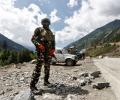
'How Xi Jinping will withdraw the aggression and justify it to his Communist party in case of a negotiated settlement might be his biggest headache.' 'Unless he is ready to gamble on an armed conflict, whose outcome given India's battle-readiness and determination is always uncertain,' observes Virendra Kapoor.

External Affairs Minister Sushma Swaraj briefed them about the operation that destroyed Jaish-e-Mohammed's terror training camp in Balakot in Khyber Pakhtunkhwa province of Pakistan.
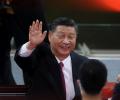
Xi's visit to Nyingchi, bordering Arunachal Pradesh, signals China's opening of another front to India in the eastern sector, observes Srikanth Kondapalli, the leading China expert.

The Politburo Standing Committee -- the most powerful body in China -- is unveiled, but in a break from Communist party convention, no successor to Xi Jinping is named.
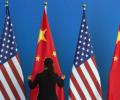
Secretary of State Mike Pompeo said he was taking action against an unspecified number of Chinese officials, including from the ruling Communist Party, under a US law that calls on China to let Americans visit Tibet.
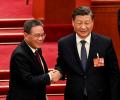
The annual session of the National People's Congress, a ceremonial body that routinely passes the proposals of the ruling Communist Party of China, approved Li Qiang's candidature after his name was proposed by Xi himself.

Why is China's supreme leader promoting Han Chauvinism so aggressively, asks Claude Arpi.
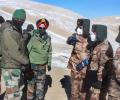
Lou also spoke about China's tensions with neighbouring countries without directly mentioning the eastern Ladakh border standoff with India since May 2020 which resulted in the Galwan Valley clash in June of that year.

'He still has to deal with party norms and traditions and has been careful to follow the order of seniority,' points out Claude Arpi.

There is no official word either from China or from India on who will represent Beijing at the upcoming G20 summit.

The talks took place in a beach resort in Benaulim on the sidelines of a meeting of the Council of Foreign Ministers of the Shanghai Cooperation Organisation.

Speculation is rife that Xi is likely to make an attempt to initiate peace talks between Russia and Ukraine to end the ongoing conflict in Ukraine.

Communist Party of India general secretary A B Bardhan said the CPC, under the guidance of the Deng Xiaoping Theory, the important thought of 'Three Represents' and the Scientific Outlook on Development, has united and led the Chinese people of all ethnic groups in building socialism with Chinese characteristics, and has made tremendous achievements in various fields.

China is expected to boost its nuclear arsenal after President Xi Jinping's remarks at the key Congress of the ruling Communist Party in Beijing for the first time that Beijing will establish strong strategic deterrence, experts have said.

Taiwan considers itself a sovereign state -- but China views the self-ruled island as a breakaway province. Beijing has not ruled out the possible use of force to achieve unification.

Nepal witnessed political turbulence in 2022 that dramatically turned rivals into allies and throned former guerrilla leader Pushpa Kamal Dahal 'Prachanda' as the prime minister for a third time, as Kathmandu made efforts to balance ties with immediate neighbours India and China with high-profile talks and visits.

Several videos have emerged on social media which showcased people chanting slogans against restrictions imposed by the Chinese government to curb the spread of Covid.

There are signs of China's external behaviour becoming more aggressive in the coming years. If that happens, strategic implications for neighbours having territorial disputes with China can become deeper and imperatives can rise for the former to counteract, says D S Rajan

The Chinese government on Saturday ordered the release of people detained over a host of coronavirus-related incidents, a day ahead of Beijing's plan to scrap its three-year-old stringently implemented zero-Covid policy.

Photos circulating in social media on Thursday showed two banners hung on an overpass of a major thoroughfare in the northwest of the Chinese capital, protesting against Xi's unpopular zero-COVID policy and authoritarian rule.

Officials said 387 passengers were aboard two flights from Toronto and Singapore on the day the country ended its strict COVID-19 restrictions for travellers.
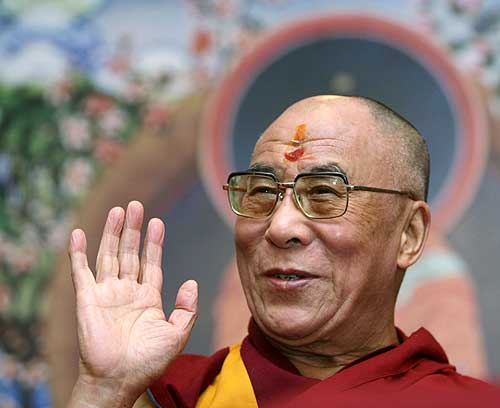
'The first time that China alleged the Dalai Lama was 'anti-national' and 'unpatriotic' was after he affirmed that Arunachal Pradesh and Tawang are part of India,' points out former RA&W official Jayadeva Ranade.

'Why did your generals try to grab a few square kilometres of Indian territory in Ladakh?' 'And what happened to the hard work that you and Prime Minister Modi put into the Wuhan and Mamallapuram meets?' Claude Arpi writes a letter to Xi Jinping, China's self-styled supreme leader, who turns 68 today, June 15.
'To summarise, PM Modi's failures in the last nine years can be categorised under 'durniti' (bad policies), 'anyay' (injustice) and - perhaps most importantly - 'badniyat' (ill intention)'

India needs to take note of China's assertiveness in implementing its national security law as also its recently exhibited sensitivity to criticism of Xi Jinping by the Indian media, says former senior R&AW officer and China expert Jayadeva Ranade.
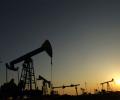
Indian officials will focus on expanding the country's footprint in oil-rich Siberia when they meet their Russian counterparts at the four-day 7th Eastern Economic Forum beginning Monday in Vladivostok. The two sides will discuss the possibility of joint oil exploration in the area and cooperation in running offshore oil and gas fields Western companies are in the process of exiting, officials said in New Delhi. Pavan Kapoor, India's ambassador to Russia, will lead the official-level talks at the summit scheduled September 5-8.
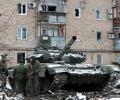
The fault line between the West and Russia has widened into a deep chasm and this is likely to endure in the foreseeable future. Far from forcing its way into the European tent, Russia may be reduced to the status of an even more sullen and weakened bystander on its periphery. The US appears to have won this hand with little cost to itself, observes former foreign secretary Shyam Saran.

'India has ramped up infrastructure on its side, so the Chinese military is finding Indian soldiers in locations where they are not used to seeing an Indian footprint,' points out Harsh V Pant.
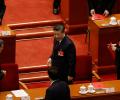
China's parliament on Thursday adopted the 14th Five-Year Plan, the mega blueprint containing billions of dollars worth of projects, including the controversial hydropower project on the Brahmaputra river in Tibet close to the Arunachal Pradesh border over which India has raised concerns.

'The supreme art of war is to subdue the enemy without fighting.' Former RA&W official Jayadeva Ranade explains what China's military reforms mean for the world.
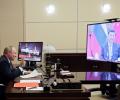
Chinese President Xi Jinping on Tuesday issued a new mobilisation order for the training of armed forces with a focus on developing an elite force capable of fighting and winning wars.
China on Tuesday hoped that Congress president Sonia Gandhi's upcoming visit to the Communist nation would promote mutual understanding between the two countries and enhance bilateral ties as well as cooperation in various fields.

The Department of Commerce alleged that Huawei was engaged in activities that are contrary to US national security or foreign policy interest.
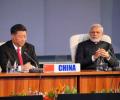
'Under General Secretary of the Chinese Communist Party (CCP) Xi Jinping, Beijing has stepped up its aggressive foreign policy toward New Delhi. Since 2013, China has engaged in five major altercations with India along the Line of Actual Control (LAC),' said a brief issued by US-China Economic and Security Review Commission.
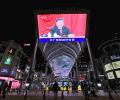
Support from the committee gives Xi an indefinite extension on the reins of power, which will surely result in hawkish and insular policies. It does not bode well for relations with the USA, or with anyone else who does not bow the knee to Beijing, for that matter.
UPA Chairperson Sonia Gandhi left for New Delhi on Saturday evening after attending the Olympics opening ceremony.
